Salesforce Alternatives in 2026: 12 CRMs Compared (with Pricing)
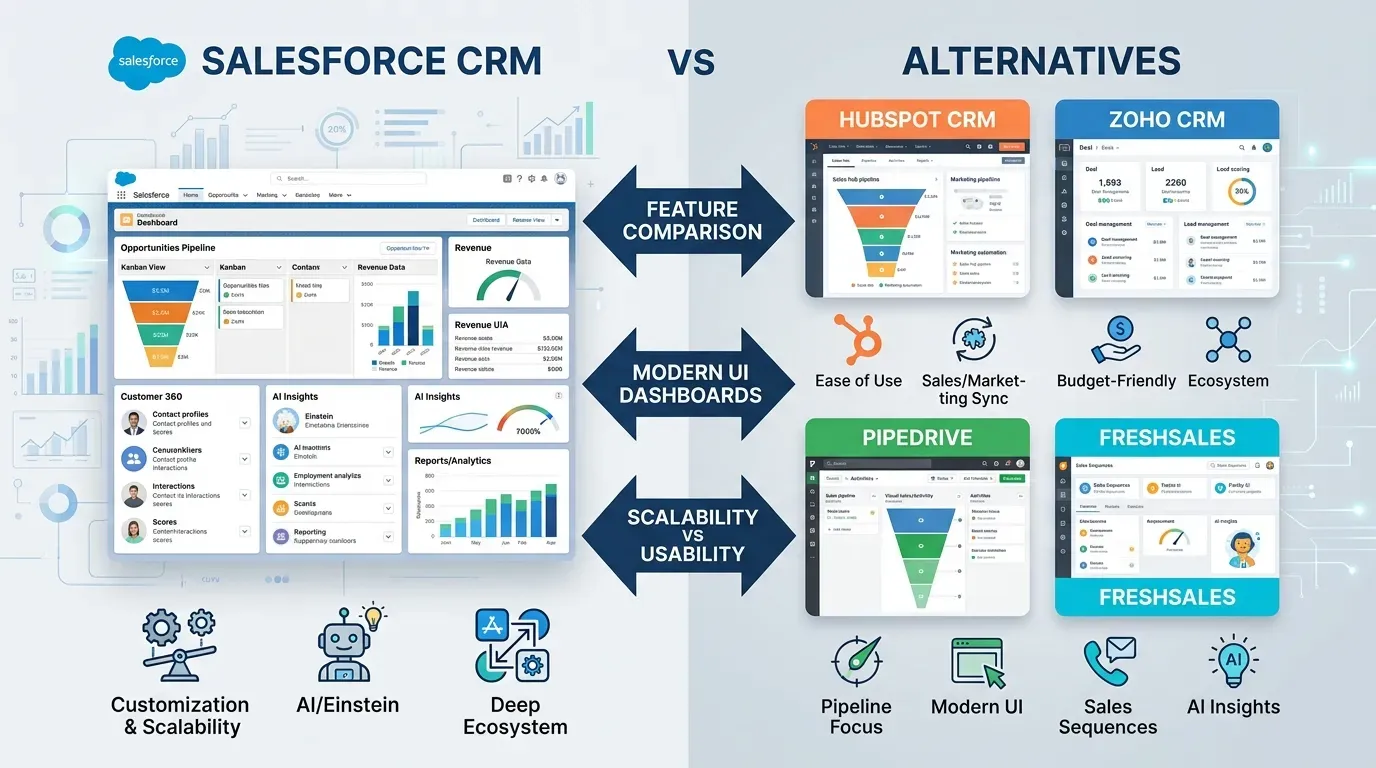
Salesforce is the category leader for good reasons — depth of customization, ecosystem scale, and 25 years of platform maturity. It’s also the most-expensive-per-feature CRM in the market, and at SMB and mid-market scale, the cost-to-value ratio often doesn’t justify the spend. The good news: in 2026, the alternatives are dramatically better than they were even three years ago.
This guide is an independent comparison of the best Salesforce alternatives, organized by what specific Salesforce limitation they solve. Whether you’re trying to escape pricing, simplify implementation, or just pick something different from day 1, you’ll find the right fit here — with direct links to start free trials.
Why companies look for Salesforce alternatives
Five reasons surface repeatedly:
- Pricing escalation. Salesforce Sales Cloud Enterprise sits at $165/user/month list. Add Service Cloud, Marketing Cloud, AppExchange apps, Premier Support, and admin headcount, and a 100-user deployment can easily exceed $500K/year all-in.
- Time to value. A typical Salesforce implementation runs 4–18 months. Many alternatives deploy in 2–8 weeks for similar SMB use cases.
- Admin overhead. Salesforce typically requires 1 admin per 30–50 users. That’s expensive headcount and a single-point-of-failure risk.
- Customization complexity. Heavily customized Salesforce orgs become hard to upgrade, hard to onboard new admins to, and hard to migrate.
- Multi-cloud sprawl. Companies often buy multiple clouds (Sales + Service + Marketing) and use only one fully. Single-purpose alternatives can be cheaper and more focused.
If any of these resonate, an alternative is worth evaluating.
The best Salesforce alternatives in 2026
1. HubSpot CRM (and Sales/Service/Marketing Hubs)
The most-cited Salesforce alternative for SMB and mid-market. HubSpot started as a marketing platform and has built credible Sales, Service, and CMS hubs around the same data model. The free CRM is a category-defining product.
Strengths vs Salesforce:
- Significantly easier to deploy and learn
- Marketing-sales alignment is native, not bolted on
- Free tier is genuinely useful
Weaknesses vs Salesforce:
- Customization ceiling is lower
- Pricing escalates fast across hubs
- Less suited for complex multi-team enterprise sales
Pricing: Free tier; Sales Hub Pro $100/seat/mo; Enterprise $150 Best for: SMB through mid-market; marketing-led organizations Migration tooling: HubSpot Salesforce migration guide →
2. Microsoft Dynamics 365 Sales
The closest enterprise Salesforce alternative — comparable feature depth, similar pricing tier, dramatically better Microsoft 365 integration.
Strengths vs Salesforce:
- Tight Microsoft 365, Teams, Outlook integration
- Power Platform extensibility
- Copilot AI built into the workflow
- Often cheaper when bundled with Microsoft enterprise agreements
Weaknesses vs Salesforce:
- Smaller AppExchange-equivalent ecosystem
- Steeper learning curve outside Microsoft ecosystem
Pricing: Sales Pro $65; Sales Enterprise $105; Premium $150 Best for: Microsoft-heavy enterprises, financial services, manufacturing
3. Zoho CRM (especially Enterprise tier)
The best feature-to-price alternative. Zoho CRM Enterprise delivers ~80% of Salesforce Enterprise functionality at ~25% of the price.
Strengths vs Salesforce:
- Dramatically lower TCO
- Zoho One bundle includes 45+ apps (CRM + finance + HR + projects) for $37/user/mo
- Enterprise tier handles real complexity
Weaknesses vs Salesforce:
- UX feels dense
- Smaller partner ecosystem
- Support quality is uneven
Pricing: Standard $14; Professional $23; Enterprise $40; Ultimate $52 Best for: Mid-market; budget-conscious companies needing real customization
4. SugarCRM Enterprise
The leading independent enterprise CRM. Available cloud-hosted or self-hosted, with transparent pricing and deep customization.
Strengths vs Salesforce:
- Self-hosting option for compliance-sensitive workloads
- Transparent pricing
- Time-aware data model (sees how deals evolve)
Weaknesses vs Salesforce:
- Smaller ecosystem
- Less AI maturity
Pricing: Sell $80/user/mo; Enterprise $135/user/mo Best for: Enterprises wanting independence from hyperscalers, regulated industries
5. Pipedrive
The best visual sales pipeline alternative for sales-led teams that don’t need multi-cloud breadth.
Strengths vs Salesforce:
- Faster to deploy and use
- Significantly cheaper
- Designed by salespeople for salespeople
Weaknesses vs Salesforce:
- Limited marketing functionality
- Less suited for service or support workflows
- Reporting is shallower at lower tiers
Pricing: Essential $14; Advanced $29; Pro $59; Power $69; Enterprise $99 Best for: Pure sales teams under 100 reps, B2B services, agencies
6. Freshsales (Freshworks)
The Freshworks CRM offering. Built-in phone, email, and AI-driven lead scoring at lower price points than Salesforce equivalents.
Strengths vs Salesforce:
- Built-in phone and SMS at base tier
- AI lead scoring at SMB pricing
- Lower TCO
Weaknesses vs Salesforce:
- Smaller ecosystem
- Less customization depth at lower tiers
Pricing: Free; Growth $11; Pro $47; Enterprise $71 Best for: Inside-sales teams, mid-market
7. Monday Sales CRM
Monday’s CRM benefits from the parent platform’s project management strengths.
Strengths vs Salesforce:
- Visual, customizable boards
- Strong project + sales hybrid workflows
- Faster to deploy
Weaknesses vs Salesforce:
- Newer; less depth in pure sales features
- Smaller ecosystem
Pricing: Basic $12; Standard $17; Pro $28; Enterprise (custom) Best for: Agencies, professional services, project-based sales
8. Close CRM
Built for high-velocity inside sales. Native dialer, SMS, email sequences in one window.
Strengths vs Salesforce:
- All-in-one for outbound (calling + sequences + email)
- No separate dialer or sequence tool needed
- Faster to deploy
Weaknesses vs Salesforce:
- Less suited for complex enterprise sales
- Limited service/support functionality
Pricing: Startup $49; Pro $99; Enterprise $139 Best for: SDR/BDR teams, high-volume outbound
9. Insightly
Mid-market CRM with built-in project management — useful for businesses where every deal becomes a project.
Strengths vs Salesforce:
- Built-in project management
- QuickBooks and G Suite integration
- Mid-market pricing
Weaknesses vs Salesforce:
- Smaller ecosystem
- Less AI maturity
Pricing: Plus $29; Professional $49; Enterprise $99 Best for: Professional services, agencies, project-driven sales
10. Keap (formerly Infusionsoft)
Combined CRM + email marketing automation + e-commerce for small businesses. A simpler alternative to Salesforce + Marketing Cloud.
Strengths vs Salesforce:
- All-in-one (CRM + automation + payments)
- Designed for small business; faster to deploy
Weaknesses vs Salesforce:
- Limited at scale
- UX is dated
Pricing: Pro $159/mo (1,500 contacts, 2 users); Max $229/mo Best for: Solo entrepreneurs and small agencies wanting CRM + marketing in one tool
11. Creatio
Low-code BPM + CRM platform. Strong choice when business processes need workflow automation alongside CRM.
Strengths vs Salesforce:
- Low-code platform (faster customization)
- Combined BPM + CRM
- Mid-tier pricing
Weaknesses vs Salesforce:
- Smaller partner ecosystem
- Less brand recognition
Pricing: Growth $25; Enterprise $55; Unlimited $85 Best for: Process-heavy industries, financial services, mid-market
12. Bitrix24 (Free / Mid-tier)
For SMBs wanting a Salesforce alternative at near-zero cost.
Strengths vs Salesforce:
- Free for unlimited users
- Includes project management, chat, intranet
- Affordable paid tiers
Weaknesses vs Salesforce:
- UX is dated
- Limited at enterprise scale
Pricing: Free; paid from $49/mo flat Best for: Bootstrap teams, small businesses on tight budgets
Quick comparison table
| Alternative | Best replacing | Pricing tier | Best for |
|---|---|---|---|
| HubSpot | Sales/Service/Marketing Cloud | $20–$150/seat/mo | SMB-mid market all-in-one |
| Dynamics 365 | Sales Cloud Enterprise | $65–$150/seat/mo | Microsoft enterprises |
| Zoho CRM Enterprise | Sales Cloud Enterprise | $40/seat/mo | Budget-conscious mid-market |
| SugarCRM | Sales Cloud Enterprise | $135/seat/mo | Independent / self-hosted |
| Pipedrive | Sales Cloud Pro | $14–$99/seat/mo | Pure sales pipeline |
| Freshsales | Sales Cloud Pro | $11–$71/seat/mo | Inside sales w/ phone |
| Monday CRM | Sales Cloud (project-style) | $12–$28/seat/mo | Agencies, services |
| Close | Sales Cloud + dialer add-ons | $49–$139/seat/mo | Outbound velocity teams |
| Insightly | Sales Cloud + project | $29–$99/seat/mo | Professional services |
| Keap | Sales Cloud + Marketing Cloud (SMB) | $159–$229/mo | Solo entrepreneurs |
| Creatio | Sales Cloud (process-heavy) | $25–$85/seat/mo | BPM + CRM use cases |
| Bitrix24 | Sales Cloud (free tier) | Free–$49/mo | Bootstrap teams |
How to migrate from Salesforce (and what to expect)
A Salesforce migration is a serious project. Realistic timelines:
| Migration scope | Realistic timeline |
|---|---|
| SMB, single sales cloud, <50 users | 6–12 weeks |
| Mid-market with custom objects, 50–250 users | 3–6 months |
| Enterprise multi-cloud, 250–1,000 users | 6–18 months |
| Heavily customized enterprise | 12–24 months |
The hard parts of Salesforce migration:
- Object and field mapping. Salesforce custom objects often don’t map 1:1 to other CRMs.
- Workflow translation. Process Builder, Flow, Apex code — these don’t migrate; they need to be rebuilt.
- Integration rebuilds. Every Salesforce-connected tool needs to be reconnected to the new CRM.
- History and notes. Activity history, Chatter feeds, attachments — preserve what matters, sunset what doesn’t.
- User retraining. Most painful part of any migration; budget significant time.
Specialized Salesforce migration partners
- Trujay (now SyncMatters) — automated Salesforce migration to HubSpot, Pipedrive, others
- Import2 — multi-CRM data migration specialist
- Match My Email — focused email integration during migration
- AppShark — Salesforce-specific migration consultancy
- Bardess — broader CRM migration practice
When NOT to leave Salesforce
Despite the alternatives, sometimes Salesforce is the right answer:
- You have 500+ users with complex multi-team processes
- You’re in a regulated industry with deep verticalized Salesforce solutions (Financial Services Cloud, Health Cloud)
- You’ve already invested in heavy customization that would cost $500K+ to recreate
- Your AppExchange dependencies are critical to your operations
- Your partner ecosystem and consultant relationships are mature
- You operate globally in 50+ countries with localization, compliance, and 24/7 support needs
For these scenarios, the migration cost rarely beats the value of staying.
Common alternative-evaluation mistakes
- Comparing list prices, not negotiated prices. Salesforce will often discount 25–40% if you’re a real flight risk; alternatives also negotiate.
- Underestimating migration cost. Free alternatives aren’t free if migration costs $200K.
- Picking on features alone, ignoring ecosystem. Salesforce’s ecosystem is a real moat.
- Failing to pilot. A 30–60 day pilot with real users surfaces issues evaluation demos hide.
- Switching CRMs too often. Two switches in 5 years usually costs more than committing to one.
Frequently asked questions
What is the best Salesforce alternative?
It depends on your size and complexity. For SMBs, HubSpot CRM is the top alternative. For mid-market, Zoho CRM Enterprise offers Salesforce-grade features at one-third the price. For enterprise organizations, Microsoft Dynamics 365 is the closest direct competitor.
Why do companies migrate away from Salesforce?
The most common reasons are: total cost of ownership escalation, implementation and admin complexity, multi-cloud sprawl, AppExchange dependency, and partner ecosystem fatigue. Companies under 500 users often find alternatives deliver 80% of the value at 30–40% of the cost.
Is HubSpot a real Salesforce alternative for enterprise?
HubSpot Enterprise (Sales + Service + Marketing Hubs) has matured significantly and is a credible Salesforce alternative for organizations up to about 500–1,000 users with moderate complexity. For deeply customized sales processes or industries requiring deep verticalization, Salesforce still has the edge.
Can I migrate from Salesforce to another CRM?
Yes, but it’s a real project. Most CRMs offer Salesforce-specific migration tooling. Plan 3–6 months for SMB migrations and 6–18 months for enterprise migrations.
What’s the cheapest Salesforce alternative?
Bitrix24 (free for unlimited users), HubSpot CRM Free, and Zoho Bigin Free are genuinely free for small teams. Among paid CRMs, Pipedrive Essential at $14/user/month and Zoho CRM Standard at $14/user/month are the most affordable.
Does Microsoft Dynamics 365 really compete with Salesforce?
Yes, on every enterprise dimension. Customization, AI, integration, partner ecosystem (smaller than Salesforce but mature). For Microsoft-heavy organizations, Dynamics often wins on TCO and stack alignment.
What about Oracle and SAP CRM?
Strong choices for organizations already deeply on Oracle or SAP ERP. Less useful for greenfield deployments.
How long does Salesforce migration take?
3–6 months SMB, 6–18 months enterprise. The platform switch is usually faster than the change-management work to get reps adopting the new tool.
Related guides
- Best CRM Software (overall) — full ranking across segments.
- CRM for Small Business — SMB-specific picks.
- Enterprise CRM Solutions — for 100+ rep organizations.
- HubSpot CRM Pricing — full HubSpot tier breakdown.
- CRM Implementation Services — partner selection.
Salesforce isn’t always wrong, but it isn’t always right either. The 2026 alternatives are credible, well-funded, and often better fits for SMB-mid market needs. Pick the alternative that solves the specific Salesforce pain point you’re feeling — not the one that simply costs less.