HubSpot CRM Pricing in 2026: Every Tier, Every Hub, Every Hidden Cost Explained
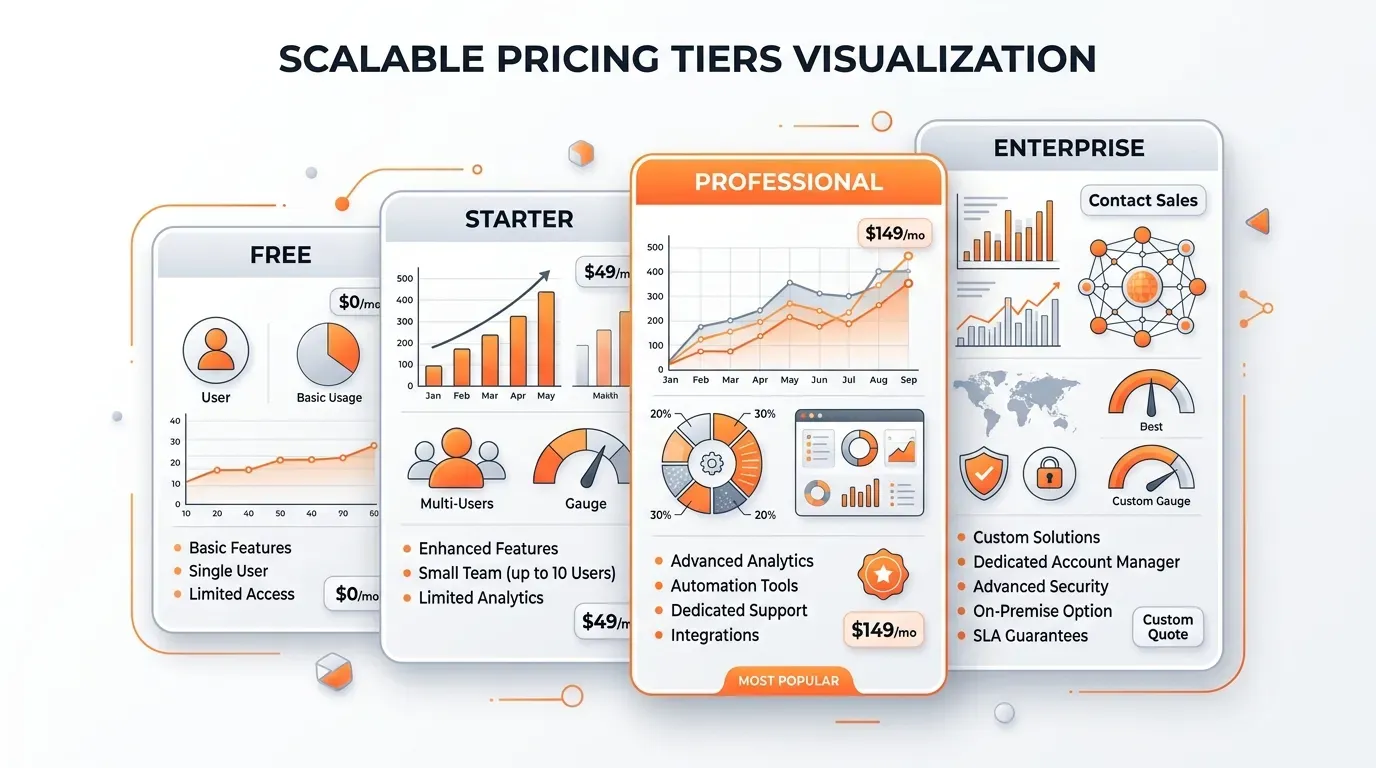
HubSpot’s pricing model is famously confusing. There are five hubs (Sales, Marketing, Service, Operations, CMS), each with four tiers (Free, Starter, Professional, Enterprise), each with different per-seat vs. per-contact-tier pricing, each with bundles, add-ons, and minimum-seat requirements. Two SMBs the same size can pay $300/month or $30,000/month depending on which hubs they enable.
This guide is the complete 2026 HubSpot pricing breakdown — every tier, every hub, every gotcha. By the end, you’ll know exactly what you’d pay for your specific situation, where you can save money, and where the pricing model has real surprises.
For an even broader comparison, see our best CRM software guide and Salesforce alternatives post.
How HubSpot pricing works
HubSpot organizes its pricing across two dimensions:
Dimension 1: The Hub (functional area)
- CRM Suite — bundles multiple hubs at a discount
- Sales Hub — pipelines, deals, automation, quotes, sequences, forecasting
- Marketing Hub — email, landing pages, forms, automation, ads, analytics
- Service Hub — ticketing, knowledge base, customer feedback, automation
- Operations Hub — data sync, programmable automation, data quality
- CMS Hub — website hosting, themes, drag-and-drop pages, A/B testing
Dimension 2: The Tier (feature depth)
- Free — generous free tier across most hubs
- Starter — entry paid tier, unlocks core paid features
- Professional (Pro) — full automation, custom reporting, advanced features
- Enterprise — full feature set, custom objects, advanced permissions, sandboxes
Crucially, pricing isn’t always per-seat. Marketing Hub charges per “marketing contact” (anyone you actively market to). Service Hub and Sales Hub charge per seat. Ops Hub charges flat. CMS Hub charges flat. This is why getting a HubSpot quote requires understanding your specific data shape.
The free tier (and why it’s so good)
The HubSpot CRM Free tier is genuinely free, with no time limit. What’s included:
- Unlimited users
- Up to 1 million contacts and companies
- Full deal pipeline and management
- Custom contact and deal properties (up to 1,000)
- Email tracking and notifications
- Meeting scheduler with calendar integration
- Live chat and basic chatbot
- Up to 2,000 marketing emails per month
- 5 documents (sales document tracking)
- 5 templates and 5 snippets
- 5 calling minutes per user per month
- Basic reporting (10 dashboards, up to 10 reports per dashboard)
What’s NOT in the free tier:
- Email sequences
- Multiple pipelines
- Custom reporting
- Workflow automation
- Lead scoring
- Marketing automation beyond basic email
- A/B testing
- Custom objects
For a small team early in their CRM journey, the free tier is genuinely usable for 6–18 months before you hit a real wall.
Sales Hub pricing (2026)
The most common paid hub for early HubSpot customers.
| Tier | Price | Min seats | Key features added |
|---|---|---|---|
| Free | $0 | Unlimited | Basic CRM (above) |
| Starter | $20/seat/mo | 1 seat | Sequences, simple automation, conversation routing, multiple deal pipelines, e-signatures |
| Professional | $100/seat/mo | 5 seats ($500/mo minimum) | Full workflow automation, custom reporting, sales analytics, forecasting, playbooks, products library |
| Enterprise | $150/seat/mo | 10 seats ($1,500/mo minimum) | Custom objects, predictive lead scoring, sandbox environment, single sign-on, advanced permissions |
Real-world Sales Hub costs
- 3-person team on Starter: $60/month
- 10-person team on Professional: $1,000/month minimum (5-seat minimum applies)
- 50-person team on Enterprise: $7,500/month
- 200-person team on Enterprise: $30,000/month
What Sales Starter actually unlocks (the most-used upgrade)
The Starter tier is the most common first paid step. Key features:
- Sequences — automated email follow-up cadences (the most common reason teams upgrade)
- Multiple deal pipelines — separate pipelines for different sales motions (new biz vs renewals, vertical-specific)
- Simple workflow automation — basic if-this-then-that automation
- Conversation routing — route inbound chats and forms to specific reps
- Customer portals — basic
- E-signatures — embedded signing in HubSpot
For most SMB teams, Sales Starter is the right tier for 12–24 months.
Sales Pro vs Enterprise
The jump from Pro to Enterprise is significant ($100 → $150/seat plus minimum-seat increase). Enterprise unlocks:
- Custom objects — model your business beyond just contacts/companies/deals
- Predictive lead scoring — AI-driven scoring vs the rules-based scoring at Pro
- Sandbox environments — test changes without affecting production
- Advanced permissions — fine-grained role-based access
- Single sign-on (SSO) — required by most enterprise IT
- Hierarchical teams — model multi-team org structures
If you’re under 50 users without strict IT requirements, Pro is usually sufficient. Enterprise is for organizations 100+ users or specific IT/compliance needs.
Marketing Hub pricing (2026)
Marketing Hub is HubSpot’s flagship product and the historical reason for the company’s existence.
Pricing is per marketing contact, not per seat. Marketing contacts are people you actively market to (send emails, run ads, etc.). You can have unlimited “non-marketing contacts” (e.g., past customers you don’t email) for free.
| Tier | Starting price | Includes | Additional contacts |
|---|---|---|---|
| Free | $0 | 2,000 marketing emails/month, basic forms, ad management | — |
| Starter | $20/mo | 1,000 marketing contacts | $20/mo per 1,000 additional |
| Professional | $890/mo | 2,000 marketing contacts | $250/mo per 5,000 additional |
| Enterprise | $3,600/mo | 10,000 marketing contacts | $100/mo per 10,000 additional |
Marketing Hub gotchas
- The price scales with marketing contact count, fast. A Pro subscription with 10,000 marketing contacts is $890 + ($250 × 1.6) ≈ $1,290/month. With 50,000 contacts, it’s $890 + ($250 × 9.6) ≈ $3,290/month.
- The contact tier upgrade prompt is aggressive. When you hit your tier limit, HubSpot pushes upgrade. You can manage by setting contacts to non-marketing status.
- Pro is required for full marketing automation. Starter has limited automation; serious marketers need Pro at minimum.
- Enterprise is required for adaptive testing, multi-touch attribution, and advanced campaigns. A real jump in capability.
Real-world Marketing Hub costs
- Solo marketer at Starter, 1,000 contacts: $20/month
- Mid-market team at Pro, 10,000 contacts: ~$1,290/month
- Enterprise team at Enterprise, 100,000 contacts: ~$4,600/month
Service Hub pricing
Customer support and success tooling.
| Tier | Price | Min seats | Key features |
|---|---|---|---|
| Free | $0 | Unlimited | Basic ticketing, live chat, knowledge base (limited) |
| Starter | $20/seat/mo | 1 | Tickets, live chat, conversational bots, simple ticket automation |
| Professional | $100/seat/mo | 5 | Customer feedback (NPS, CSAT), full knowledge base, customer portals, automation |
| Enterprise | $150/seat/mo | 10 | Custom objects, playbooks, conversation intelligence, single sign-on |
Operations Hub pricing
Data sync, programmable automation, data quality automation. Often the underrated hub for technical teams.
| Tier | Price | Includes |
|---|---|---|
| Free | $0 | Data sync (HubSpot ↔ ~80 apps), one-way connections |
| Starter | $20/mo | Two-way sync, data sync history |
| Professional | $720/mo | Programmable automation (custom code), data quality automation |
| Enterprise | $2,000/mo | Datasets, custom data validation, advanced ops |
Compare Operations Hub tiers →
CMS Hub pricing
Website hosting + drag-and-drop content management.
| Tier | Price | Includes |
|---|---|---|
| Starter | $25/mo | Website hosting, premium themes, multi-language pages |
| Professional | $360/mo | A/B testing, dynamic content, SEO recommendations, custom CDN |
| Enterprise | $1,200/mo | Memberships, multi-brand support, partitioning, hierarchical teams |
CRM Suite (bundled hubs)
If you need multiple hubs, the CRM Suite bundle saves 20–25% vs. à la carte.
| Tier | Price | What’s included |
|---|---|---|
| Starter Customer Platform | $20/seat/mo (5-seat min) | Marketing + Sales + Service + Ops + CMS Starter |
| Professional Customer Platform | $1,300/mo (5 seats included) | All hubs at Professional tier |
| Enterprise Customer Platform | $4,300/mo (7 seats included) | All hubs at Enterprise tier |
If you’re using 3+ hubs, the suite bundle almost always wins. If you’re only using 1–2 hubs, à la carte is usually cheaper.
Add-ons and additional costs
The line items that surprise first-time HubSpot buyers:
Onboarding fees (one-time)
- Starter onboarding: Free (self-service)
- Professional onboarding: $500–$3,000 one-time, depending on hub
- Enterprise onboarding: $3,000–$7,000 one-time
Premium add-ons
- Dedicated IP for email: $500/month (Marketing Hub Pro+)
- Custom reporting builder: Included in Professional+
- API call increases: Free up to limits, then per-call pricing
- Sales Hub Cookieless Tracking add-on: Included in Pro+
- HubSpot AI add-ons (Breeze AI Agents, Content AI): Usage-based, varies
Implementation partner fees
For mid-market and enterprise rollouts, expect:
- Starter implementation by a partner: $2,500–$10,000
- Pro implementation by a partner: $10,000–$50,000
- Enterprise implementation: $50,000–$200,000+
The HubSpot Solutions Directory lists certified partners.
Annual vs monthly billing
HubSpot offers monthly and annual prepay options. Annual gets you 5–10% off list. Multi-year contracts negotiate higher.
For commitments above $50K/year, you can negotiate:
- 15–25% discount on list pricing
- Free months
- Locked pricing for the contract term (avoids annual list-price increases)
- Reduced or waived onboarding fees
Real-world pricing scenarios
Solopreneur
- HubSpot CRM Free
- Total: $0/month
5-person SMB sales team
- 5 × Sales Hub Starter ($20/seat) = $100/month
- Total: ~$100/month
15-person mid-market team (sales + marketing)
- 15 × Sales Hub Pro ($100/seat) = $1,500/month
- Marketing Hub Pro (10,000 contacts) ≈ $1,290/month
- Total: ~$2,790/month or $33K/year
50-person mid-market team (sales + marketing + service)
- 50 × Sales Hub Pro = $5,000/month
- Marketing Hub Pro (50,000 contacts) ≈ $3,290/month
- 10 × Service Hub Pro = $1,000/month
- Total: ~$9,290/month or $111K/year
200-person enterprise (full stack)
- 200 × Sales Hub Enterprise = $30,000/month
- Marketing Hub Enterprise (250K contacts) ≈ $6,000/month
- 30 × Service Hub Enterprise = $4,500/month
- Operations Hub Enterprise = $2,000/month
- CMS Hub Enterprise = $1,200/month
- Total: ~$43,700/month or $524K/year
Implementation, onboarding, and admin headcount add another 20–30% in year 1.
Common HubSpot pricing surprises
- Marketing contact creep. Form submissions, ad clicks, and chatbot conversations create new marketing contacts. The contact-tier upgrade prompt arrives sooner than expected.
- 5-seat Pro minimum. A 3-person team can’t get Sales Pro at 3 × $100 = $300; the minimum is 5 × $100 = $500.
- Hub interdependence. Some workflows require both Sales Pro and Service Pro, doubling cost.
- Annual contract cancellation. HubSpot annual contracts auto-renew; cancellation requires advance notice (typically 60 days).
- Add-on stacking. Premium add-ons (dedicated IP, additional storage) compound monthly cost.
- Onboarding fees aren’t optional. Pro+ tiers require either HubSpot onboarding or a certified partner.
How to negotiate HubSpot pricing
For deals above $25K/year, real negotiation is possible:
- Get a competitor quote. A HubSpot rep with a Salesforce or Zoho quote in hand will get more aggressive.
- Time your renewal. Q4 (Oct–Dec) is most flexible.
- Multi-year commitment. Lock in 2–3 years for 10–20% discount.
- Bundle hubs. CRM Suite bundles save vs à la carte; but only commit to hubs you’ll use.
- Negotiate price-lock language. Annual list-price increases compound; lock pricing for contract term.
- Free seats for onboarding period. Common concession: first 90 days at half-price for new seats.
- Push back on onboarding fees. Often waivable if you commit to a higher annual.
When HubSpot is worth it
HubSpot is the right fit when:
- You need marketing + sales aligned on the same data
- You’re doing inbound content marketing and the Marketing Hub features fit
- Time-to-value matters more than ceiling
- Your team values UX and adoption
- You’re between SMB and mid-market (5–500 users)
HubSpot is NOT the right fit when:
- You’re a pure sales org (Pipedrive, Close, or Salesforce often cheaper and better)
- You have very complex multi-team enterprise sales (Salesforce wins)
- You’re cost-sensitive and only need basic CRM (Zoho, Bitrix24, Less Annoying CRM)
- You’re already deep in Microsoft ecosystem (Dynamics 365 often better)
Frequently asked questions
Is HubSpot CRM really free?
Yes. The HubSpot CRM Free tier is genuinely free with unlimited users, up to 1 million contacts, full pipeline and deal tracking, email integration, meeting scheduler, and basic email marketing. Costs only kick in for advanced features in Sales Hub, Marketing Hub, or Service Hub.
How much does HubSpot Pro cost?
Sales Hub Pro is $100/seat/month with a 5-seat minimum ($500/mo minimum). Marketing Hub Pro starts at $890/month. Service Hub Pro is $100/seat/month with 5-seat minimum. Total Pro tier across all 5 hubs runs roughly $25K–$50K/year for a typical SMB.
What’s the cheapest paid HubSpot plan?
Sales Hub Starter at $20/seat/month and Marketing Hub Starter at $20/month (1,000 marketing contacts) are the entry paid tiers.
Is HubSpot worth the price?
For marketing-led SMB and mid-market companies, yes. For pure sales teams, HubSpot is often more expensive than focused sales CRMs. The decision usually hinges on whether you need marketing automation alongside CRM.
Can I downgrade my HubSpot plan?
Yes, but downgrades take effect at the next billing cycle. Some features become inaccessible immediately when you downgrade.
Does HubSpot offer discounts for nonprofits?
Yes. HubSpot for Nonprofits offers up to 40% off Marketing, Sales, and Service Hubs for qualifying 501(c)(3) organizations. Apply through the HubSpot for Nonprofits program.
Does HubSpot offer discounts for startups?
Yes. HubSpot for Startups offers 30–90% off depending on funding stage, for up to 3 years. Eligibility requires being a member of an accredited incubator, accelerator, or VC partner.
How do I cancel HubSpot?
Annual contracts auto-renew unless cancelled with proper notice (typically 60+ days before renewal). Submit cancellation through the HubSpot Customer Account UI or contact your CSM.
What happens to my data if I cancel HubSpot?
You retain access to your data for 30 days post-cancellation for export purposes. After that, HubSpot retains data for legal/compliance purposes but you lose UI access.
Related guides
- Best CRM Software — full comparison across SMB, mid-market, enterprise.
- CRM for Small Business — for SMB-focused alternatives.
- Salesforce Alternatives — broader alternative comparison.
- Enterprise CRM Solutions — for organizations evaluating HubSpot Enterprise.
- CRM Implementation Services — partner selection.
HubSpot pricing rewards careful planning and punishes ad-hoc upgrades. Map your actual feature needs to the right tier, negotiate annual contracts strategically, and avoid the seat-count minimums that double your bill at small scales.