AI Content Detector & Plagiarism Checker — Free, Accurate, No Sign-Up
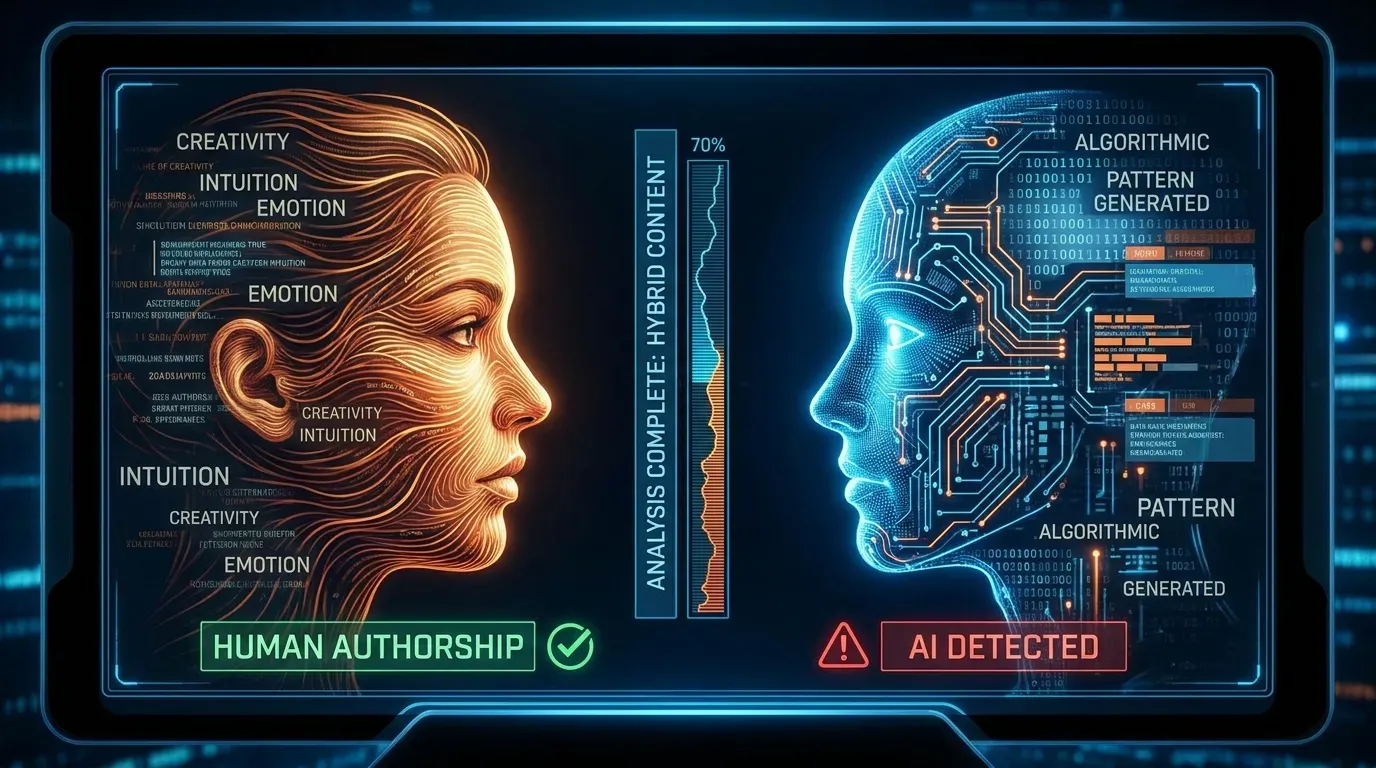
In 2026, distinguishing AI-generated text from human writing — and catching plagiarized text from either — has become a routine task for students, teachers, editors, content managers, and hiring managers reviewing application essays and writing samples. The tools to do it are scattered, often expensive, and frequently inaccurate. Several charge $20+/month for what should be a quick paste-and-scan operation.
This guide explains how AI detection actually works (perplexity, burstiness, n-gram analysis), how plagiarism scanning compares against billions of indexed pages, and the best free and paid AI detectors and plagiarism checkers available in 2026 — so you can pick the right tool for your role and budget.
Why students, teachers, and editors need both checks
A 2024 Stanford study estimated that 40% of student writing submitted in college courses included AI-generated content, with most of it lightly edited. Teachers don’t always object — many incorporate AI as a learning tool — but they need to know.
Editors face the same issue with freelance contributors. SEO content agencies face it with subcontractors. Hiring managers face it with application essays and writing samples. The question isn’t always “is this allowed?” — sometimes it’s just “is this what I think it is?”
Plagiarism is the older, related problem. Pre-AI, copy-paste from Wikipedia or another paper was the dominant form of academic dishonesty. Post-AI, the landscape includes both: traditional copy-paste plus AI-generated paraphrase of existing material that’s harder to detect manually.
A combined checker addresses both:
- AI detection asks: was this text statistically likely produced by an LLM?
- Plagiarism detection asks: was this text already published elsewhere?
Used together, they give a near-complete picture of a document’s originality.
What an AI detector actually measures
There’s no magic. AI detectors look for statistical patterns in text that differ from typical human writing.
Perplexity
Perplexity measures how “surprising” each word is given the words before it. Human writing has variable perplexity — moments of unexpected word choice, strong opinions, idiosyncratic phrasings. LLM output tends to have lower, more uniform perplexity because it samples from high-probability words at each step.
A document with consistently low perplexity → likely AI. A document with bursty, variable perplexity → likely human.
Burstiness
Burstiness measures variation in sentence length and structure. Humans write some short sentences, some long, some compound, some fragmentary. LLMs produce more uniformly mid-length sentences with consistent grammatical structures.
Low burstiness → AI signal. High burstiness → human signal.
N-gram repetition patterns
LLMs over-use certain phrases (“it’s worth noting”, “in conclusion”, “delve into”, “tapestry of”) at frequencies higher than human writing. Detectors maintain lists of high-signal phrases and weight their occurrence.
Stylometry
Vocabulary diversity, function-word ratios, type-token ratios, average syllables per word — collectively called “stylometric features.” Each user’s writing has a unique stylometric fingerprint; LLMs have their own (different from any individual human).
Syntactic regularity
LLMs produce more regular sentence-tree structures (subject-verb-object patterns, predictable subordinate clause placement). Humans break syntactic rules more often for emphasis, voice, or rhythm.
Detection model
The above signals get combined in a classifier (typically a small transformer trained on millions of human and AI text pairs) that outputs an AI-likelihood probability between 0 and 1.
How plagiarism checking works under the hood
Plagiarism checkers find text that exists elsewhere on the web or in their indexed corpora.
N-gram fingerprinting
The submitted text is broken into overlapping word sequences (n-grams, typically 5–10 words). Each sequence becomes a “fingerprint” that gets searched against the index.
Index comparison
The checker queries an index of indexed pages — academic databases (JSTOR, IEEE, ACM), publicly indexed web pages (Common Crawl), books and references where licensed. A match means the n-gram appears in another document.
Match scoring
Number of matching n-grams + length of contiguous matches → similarity score. High score with long contiguous matches → likely direct copying. High score with scattered short matches → likely common phrases (boilerplate) or quoted material.
Source attribution
When a match is found, the checker returns the source URL or document so you can verify the match in context. Quoted material with proper citation isn’t plagiarism even if it matches; the checker flags the match and you decide.
Paraphrase detection (advanced)
Modern checkers also detect paraphrased plagiarism: the same idea expressed in different words. This uses semantic embedding similarity rather than literal n-gram matching. Less precise, useful for detecting the kind of “rewriting” that pure n-gram tools miss.
Tool usage guide
The flow is intentionally simple:
1. Paste your text
Up to 50,000 characters per scan. For longer documents, split into chunks. The text box accepts plain text, copy-pasted Word/Google Docs content, or PDF text extraction.
2. Pick your scan type
- AI detector only — fast, returns AI likelihood and confidence
- Plagiarism checker only — slower, scans web index
- Both (default) — runs in parallel, full report
3. (Optional) Adjust sensitivity
Default sensitivity is calibrated for general use. High sensitivity catches more potential issues but produces more false positives. Low sensitivity is conservative.
4. Click Scan
AI detection takes 2–5 seconds. Plagiarism scan takes 10–30 seconds depending on text length and current load.
5. Read the report
You’ll see:
- AI Score (0–100): probability the text was AI-generated
- AI confidence: how confident the model is in its score
- Plagiarism similarity %: percentage of text matching indexed sources
- Sentence-level highlighting: which sentences scored as AI-likely or as plagiarism matches
- Source list: URLs of plagiarism matches with side-by-side comparison
- Methodology summary: which signals contributed to the AI score
6. Interpret responsibly
A high AI score isn’t proof of AI writing — it’s evidence. Edge cases:
- Highly formal academic writing (technical, structured) often scores moderately AI-like even when fully human-written.
- Translated text often scores AI-like because translation tools smooth out human idiosyncrasies.
- Co-authored or heavily edited text scores in the middle.
- Short text (under 200 words) is too small for reliable detection — request longer samples when possible.
The tool provides a score and supporting evidence; the human reading the report makes the final call.
Real-world example: a teacher reviewing an essay
Mr. Patel, a high school English teacher, receives a 1,200-word essay from a student about The Great Gatsby. Something feels off — the essay is well-structured, uses correct vocabulary, but lacks the student’s typical voice.
He pastes the text.
AI Score: 87% with high confidence.
The detector highlights specific signals:
- 92% of sentences in mid-length range (15–22 words) — uniformly LLM-like
- Repeated use of “tapestry of”, “delve into”, and “intricate dance of” — high-signal LLM phrases
- Low perplexity throughout
- Stylometric drift from the student’s previous submissions in the same class
Plagiarism similarity: 4% — quoted Gatsby passages, no other matches.
The 4% plagiarism is normal for an essay quoting the source novel. The 87% AI score with this evidence is strong but not absolute proof.
Mr. Patel doesn’t accuse the student outright. He asks the student to come to office hours, talks through the essay’s argument, and asks process questions (“Walk me through how you developed this thesis”). The conversation usually clarifies whether the student’s understanding matches the document — and almost always reveals the truth respectfully.
The detector is a starting point for a conversation, not a verdict.
Benefits: academic integrity, SEO content vetting, editorial QA
Academic integrity
Teachers can spot likely AI submissions and have informed conversations rather than blanket policies. Universities use detectors as part of multi-source evidence for academic-integrity hearings.
SEO content vetting
Content agencies running freelance writer pools use detectors to verify that paid writers are actually writing — not just running prompts through ChatGPT and reformatting. SEO platforms increasingly penalize low-quality AI-generated content; vetting before publication matters.
Editorial QA
Magazines, blogs, and trade publications check submissions for both AI provenance and plagiarism. Some require disclosure if AI was used as a research or drafting aid; the detector supports the workflow.
Hiring and admissions
Application essays, writing samples, take-home assignments. Detection becomes a useful screen, especially when paired with conversation/interview to verify capability.
Self-checking your own writing
Counterintuitive but useful: writers sometimes use the detector on their own work to ensure their style isn’t drifting toward LLM-like patterns from too much AI assistance.
Use cases by user type
Students
Use the plagiarism checker to verify your own work doesn’t accidentally match published sources (sometimes happens with uncited paraphrase). Use the AI detector to check your own writing if you’ve used AI as a research aid and want to confirm the final product reads as your voice.
Teachers and professors
Spot-check submissions across a class. Build a baseline of each student’s typical AI score on written work; flag outliers. Have conversations, not accusations.
Freelance writers
Verify that your submitted work scores low on AI detection (clients increasingly require this). Run plagiarism checks pre-submission to catch unintentional matches.
Agencies and content managers
Add the checker to your editorial workflow. All submitted articles run through detection before payment is approved.
Hiring managers
Verify writing samples submitted with applications. Particularly relevant for roles requiring writing skill (content, marketing, comms, journalism).
Editors and publishers
Pre-publication QA on every submission. Catch matches with previously published work before legal issues emerge.
Limitations and false positives
Detectors aren’t perfect. Common false-positive scenarios:
Highly formal writing. Academic papers, technical documentation, and business writing already use structured, formal patterns similar to LLM output. Honest human authors of formal writing sometimes score 60–80% AI.
Non-native English writing. Non-native English speakers often write in simpler, more uniform patterns that resemble LLM output. Detection often unfairly flags ESL writing.
Translated text. Translation tools (Google Translate, DeepL) smooth out source-language idiosyncrasies, producing English that scores AI-like even when the original idea is fully human.
Co-authored / edited text. A document with multiple human authors or heavy editing often has uniform style that scores AI-like.
Short text. Detection requires statistical sample size. Texts under 200–300 words are unreliable.
Heavily paraphrased AI text. A human running AI output through 2–3 rounds of paraphrasing can defeat detection. The detector’s accuracy drops to 50–60% on heavily edited LLM output.
False negatives (missing actual AI text) happen when:
- Output was edited substantially by a human
- The original prompt produced unusually variable text
- The model used was newer than the detector’s training
- The user asked the model for “human-like” or “burstier” output specifically
Best practice: treat scores below 30% as “likely human”, 30–70% as “ambiguous, worth investigating”, and 70%+ as “likely AI, gather more evidence.” Never use a single score as standalone proof.
Best AI detectors and plagiarism checkers (2026)
For best accuracy, run text through 2+ detectors and compare. No single tool is definitive.
Best AI content detectors
- GPTZero — One of the most widely-used AI detectors; free for short samples.
- Originality.ai — Specifically built for SEO content QA; paid only.
- Copyleaks AI Content Detector — Strong accuracy across multiple LLMs; free tier available.
- Sapling AI Detector — Free with no signup; sentence-level highlighting.
- ZeroGPT — Free, no signup; quick scans.
- Writer AI Content Detector — Free tool from a content platform.
- Crossplag AI Detector — Free with paid tiers for bulk.
- Smodin AI Detector — Free, multi-language.
Best plagiarism checkers
- Turnitin — Industry standard for academic institutions; integrated into LMS platforms.
- Copyleaks Plagiarism Checker — Plus AI detection; multilingual.
- Quetext — Strong free tier with deep search.
- Grammarly Plagiarism Checker — Built into Grammarly Premium.
- Plagiarism Checker by Duplichecker — Free, no signup, suitable for short text.
- Scribbr Plagiarism Checker — Uses Turnitin’s database; pay per check.
- Unicheck — Academic-focused, used by many universities.
- Plagscan — Established plagiarism checker for institutions.
Combined AI + plagiarism platforms
- Copyleaks — Both in one; strong for content agencies.
- Originality.ai — Both detectors plus fact-checker.
- Winston AI — AI detection + plagiarism checker.
Specialized for educators
- Turnitin Originality — Includes AI writing detection.
- Brisk Teaching — Chrome extension AI detector for Google Docs.
- Revision Assistant by Turnitin — Student-facing writing feedback.
Specialized for content publishers
- Originality.ai — Built specifically for SEO content vetting.
- Content at Scale AI Detector — Free, popular among SEO agencies.
Free utilities and writing tools
- Grammarly — Grammar + plagiarism + AI detection.
- Quillbot — Paraphrasing tool (also has its own AI detector).
- Hemingway Editor — Free readability checker; good for ensuring human voice.
Quick comparison
| Tool | Best for | Free tier | Paid from |
|---|---|---|---|
| GPTZero | General AI detection | Up to ~5K chars | $10/mo |
| Originality.ai | SEO content vetting | No | $14.95/mo |
| Copyleaks | Combined AI + plagiarism | Limited | $9.99/mo |
| Turnitin | Academic | No | Institution license |
| Quetext | Free plagiarism | 500 words | $10.99/mo |
| Grammarly | Writing + plagiarism | Limited | $12/mo |
| Sapling | Free AI detection | Robust | $25/mo for teams |
Frequently asked questions
How accurate are AI content detectors in 2026?
Modern AI detectors achieve 75–92% accuracy on unedited LLM output and 50–75% on lightly edited or paraphrased AI text. Detection is fundamentally probabilistic: signals like low perplexity, low burstiness, and specific n-gram patterns suggest AI authorship but cannot be 100% certain. Treat detector output as evidence, not verdict.
Can ChatGPT-written text be detected?
Often yes, if the text is unedited. ChatGPT (and similar LLMs) tends to produce statistically smoother text — more uniform sentence lengths, more predictable word choices — than human writing. Heavy editing or paraphrasing reduces detection accuracy.
Is the plagiarism checker free and unlimited?
Yes. The plagiarism checker is free with no daily caps, no signup, and no watermark on the report. We support text submissions up to 50,000 characters per scan.
Will the tool store my submitted text?
No. Submitted text is processed in real time and not retained after the scan completes. We do not use submissions to train models, do not share text with third parties, and do not log content.
What’s the difference between this and Turnitin or GPTZero?
Turnitin is the dominant institutional plagiarism + AI checker for academia, integrated into LMS platforms. GPTZero focuses primarily on AI detection. Our tool combines both functions in one paste-and-scan UX without subscription or signup. For institutional integration (LMS, Canvas), enterprise tools have advantages; for individual use, our tool delivers similar quality at zero cost.
Can I detect AI-generated images or audio?
This tool focuses on text. AI image detectors (different technology, different signals) require purpose-built tools. AI audio detection is even earlier-stage. Watch for our companion tools as they launch.
What if my text is flagged as AI but I wrote it?
False positives happen, especially for formal, structured, or non-native English writing. If you’ve been flagged unfairly: 1) save evidence of your writing process (drafts, screenshots, version history). 2) Discuss with the teacher/editor calmly — most are reasonable when shown evidence. 3) Use multiple detectors; if scores diverge wildly across tools, the signal is unreliable. 4) Consider whether your style coincidentally resembles AI patterns and adjust naturally.
How can I make my AI-assisted writing pass detection?
The honest answer: rewrite. AI as a research aid is fine; AI as a final-draft author is the issue. The most effective “detection bypass” is also the most ethical: take the AI output as a starting point, then rewrite each paragraph in your own voice with your own examples, opinions, and idiosyncratic phrasings. The detector is measuring “human authenticity”; provide it.
In a world where AI writing is everywhere, both detection and integrity matter more, not less. Use the tool as a starting point for honest conversation, not a final judge. The goal is good writing — whether human, AI-assisted, or somewhere in between, attributed honestly.